Take a Chance on MeGames of Choice

Cooperation when players can choose the stakes of the game they play.

Christian Hilbe · Theo Saroglou   Interdisciplinary Transformation University Austria
International Conference for Social Dilemmas 2026
Shimonoseki, Japan
Motivation

Real-life partners also choose the stakes.

Cooperation research often holds the stakes constant. Strategies only decide how to act within it.

But partners also escalate, downgrade, or add safeguards. They move the relationship between forms of cooperation worth more or less.

The two games

A Safe and a Risk game, played as a repeated Prisoner's Dilemma

Safe

C
D
C
6
4
D
7
5

Risk

C
D
C
7
0
D
12
3

Risk pays more for mutual cooperation, but tempts defection harder and punishes breakdown more. Cooperating in Risk takes more trust.

EXPERIMENTAL DESIGN

Each round, both players vote on which game to play
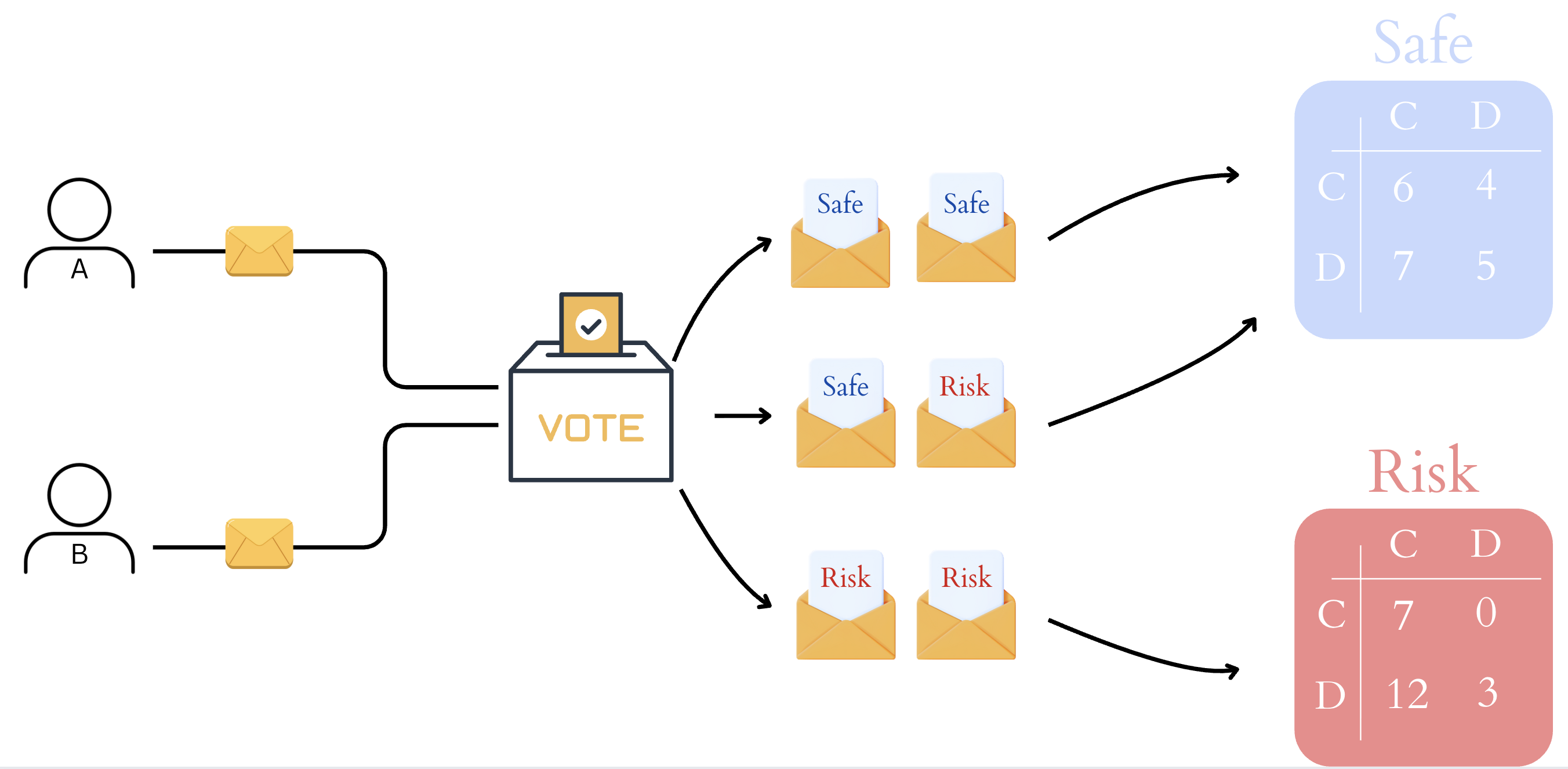
Voting flow: players A and B vote; aligned votes play that game, disagreement resolves to the default

Under Default Safe (shown), disagreement resolves to the Safe game, so the Risk game is played only by mutual consent. Default Risk flips the rule: Risk is the fallback, and staying Safe requires agreement.

EXPERIMENTAL DESIGN

Three conditions

Control

Only Safe · Only Risk

One game for all rounds. Benchmarks for cooperation in a fixed environment.

Voting

Default Safe · Default Risk

Players vote each round; the default resolves disagreement. Exposure to risk is endogenous.

Yoked

Identical voting sequences to "Voting", without the vote

Each yoked pair receives the exact Safe/Risk sequence a voting pair generated, same order and frequency, but with no control over it. Voting versus yoked isolates the effect of agency from the effect of exposure.

Hypothesis

If voting affects cooperation, cooperation will be higher in each of the games where the voting mechanism is in place compared to the conditions where the mechanism is absent.

Sample
644Participants
322Pairs
12,880Observations

Recruited on Prolific (online). Each pair played at least 20 rounds with a stochastic continuation rule (50%).

Only Safe n = 80
Default Safe n = 120
Yoked Safe n = 120
Only Risk n = 80
Default Risk n = 122
Yoked Risk n = 122
Results · cooperation by treatment

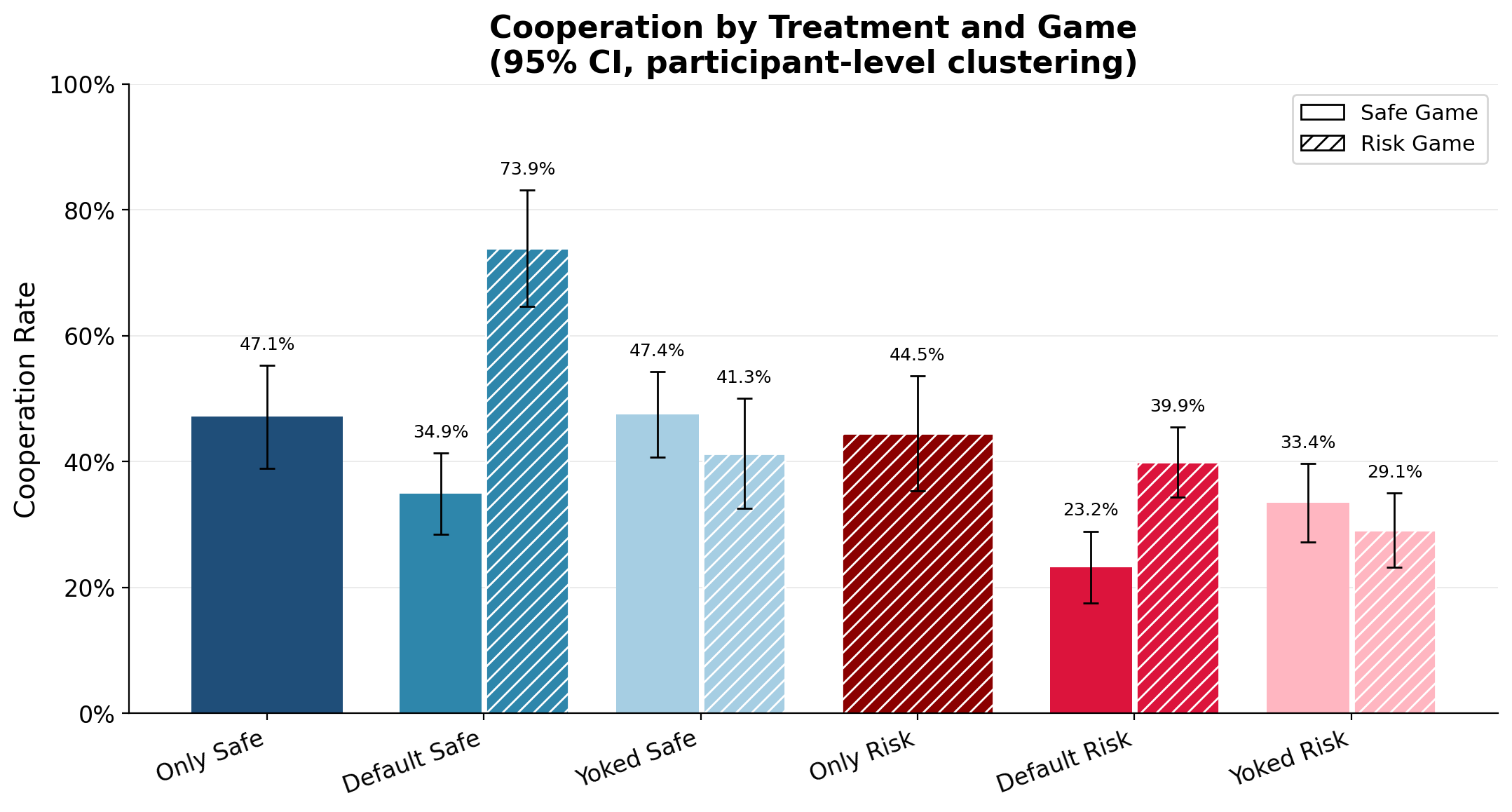
Cooperation holds everywhere, except when Risk is the default

42.7-47.1%

Only Safe, Default-Safe, Only Risk and Default-Risk cluster together.

31.2-31.8%

Both Default-Risk conditions fall.

73.9%

Cooperation in the Risk game when it is chosen from a Safe default.

Voting treatments show a large Safe/Risk gap; yoked treatments show none, indicating it is the choosing, not the exposure, that moves cooperation.
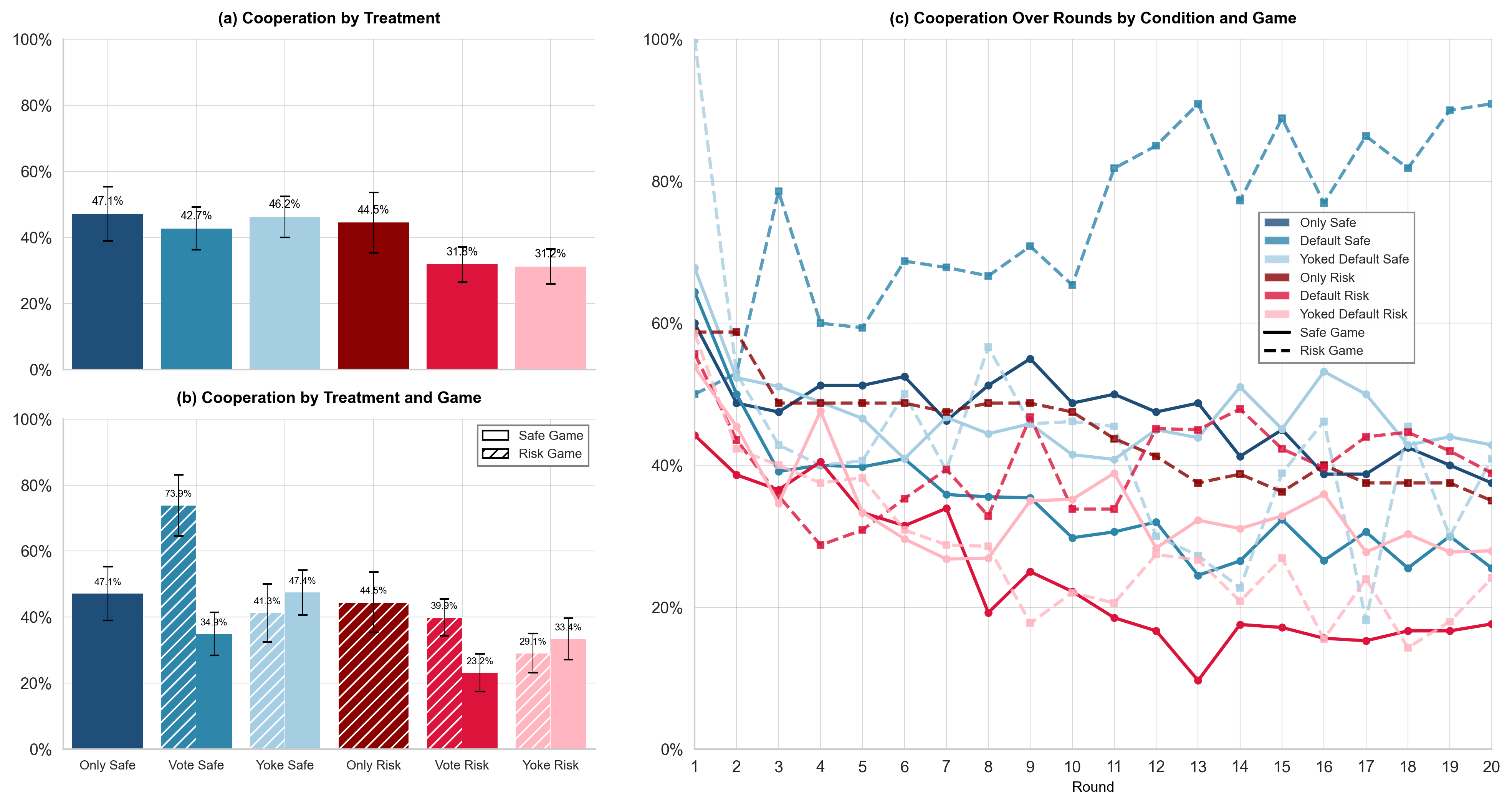
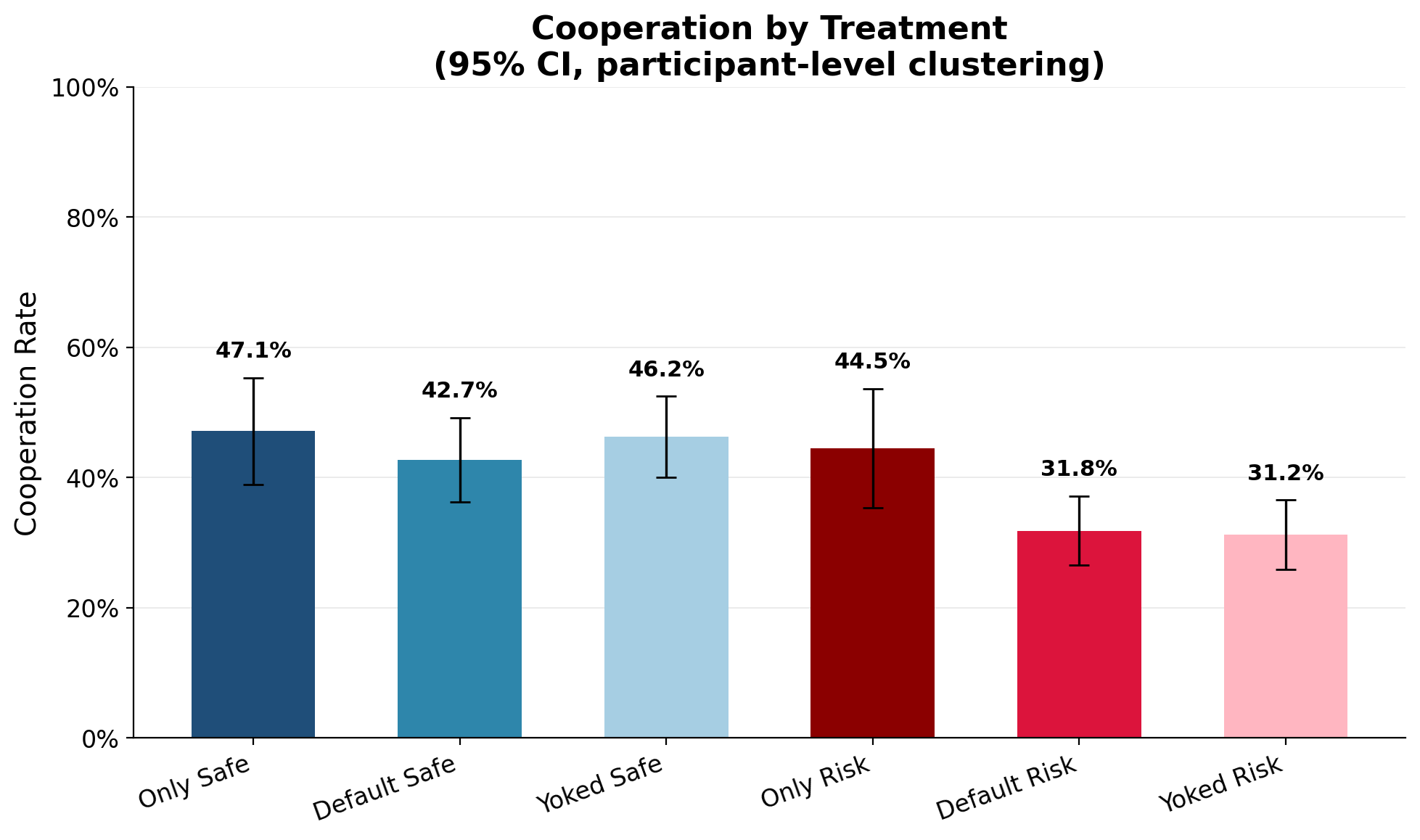
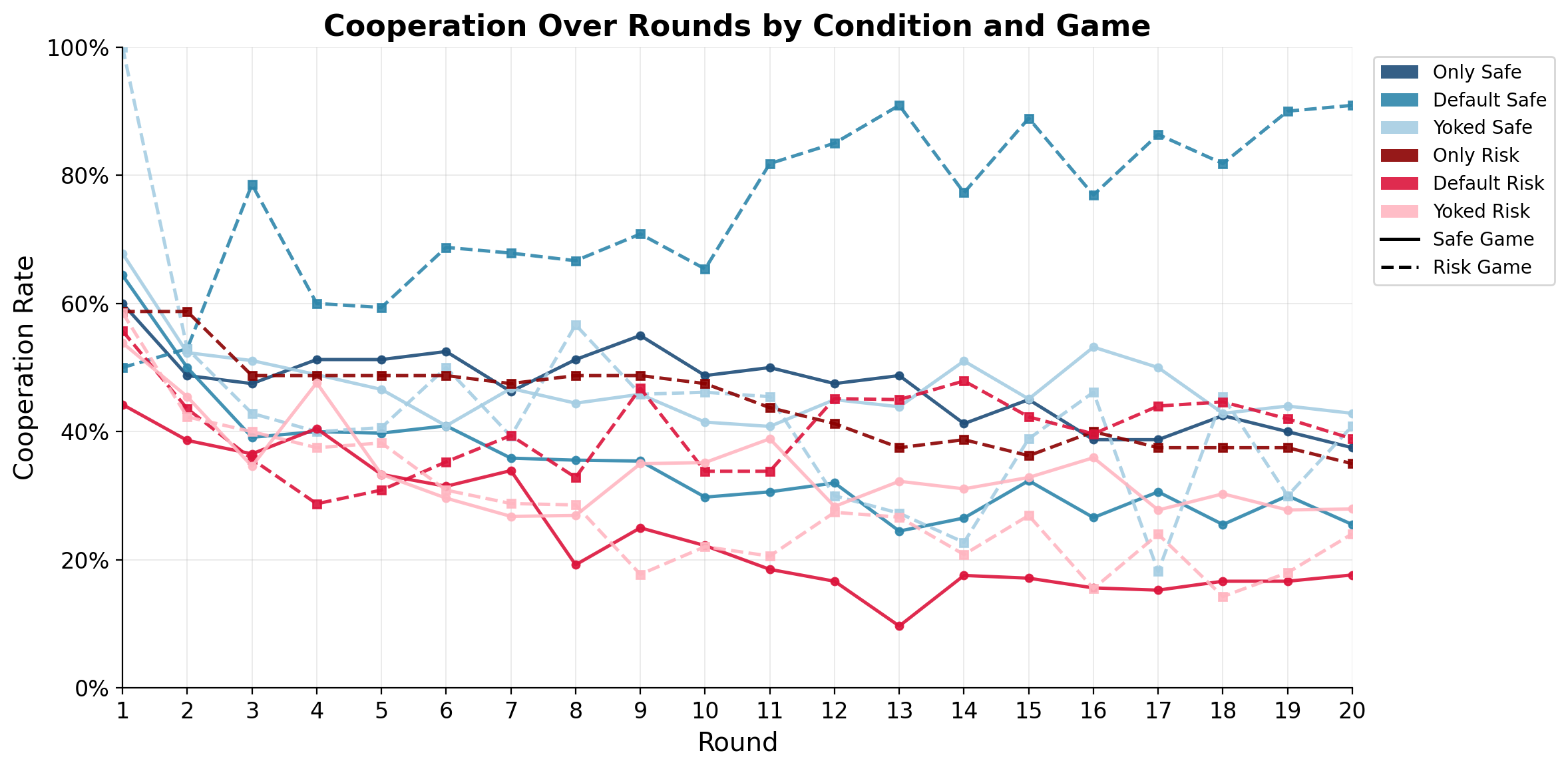
Cooperation by treatment and game, and over rounds Cooperation by treatment Cooperation by treatment and game Cooperation over rounds
All panels By treatment By game Over rounds
Results · voting alignment

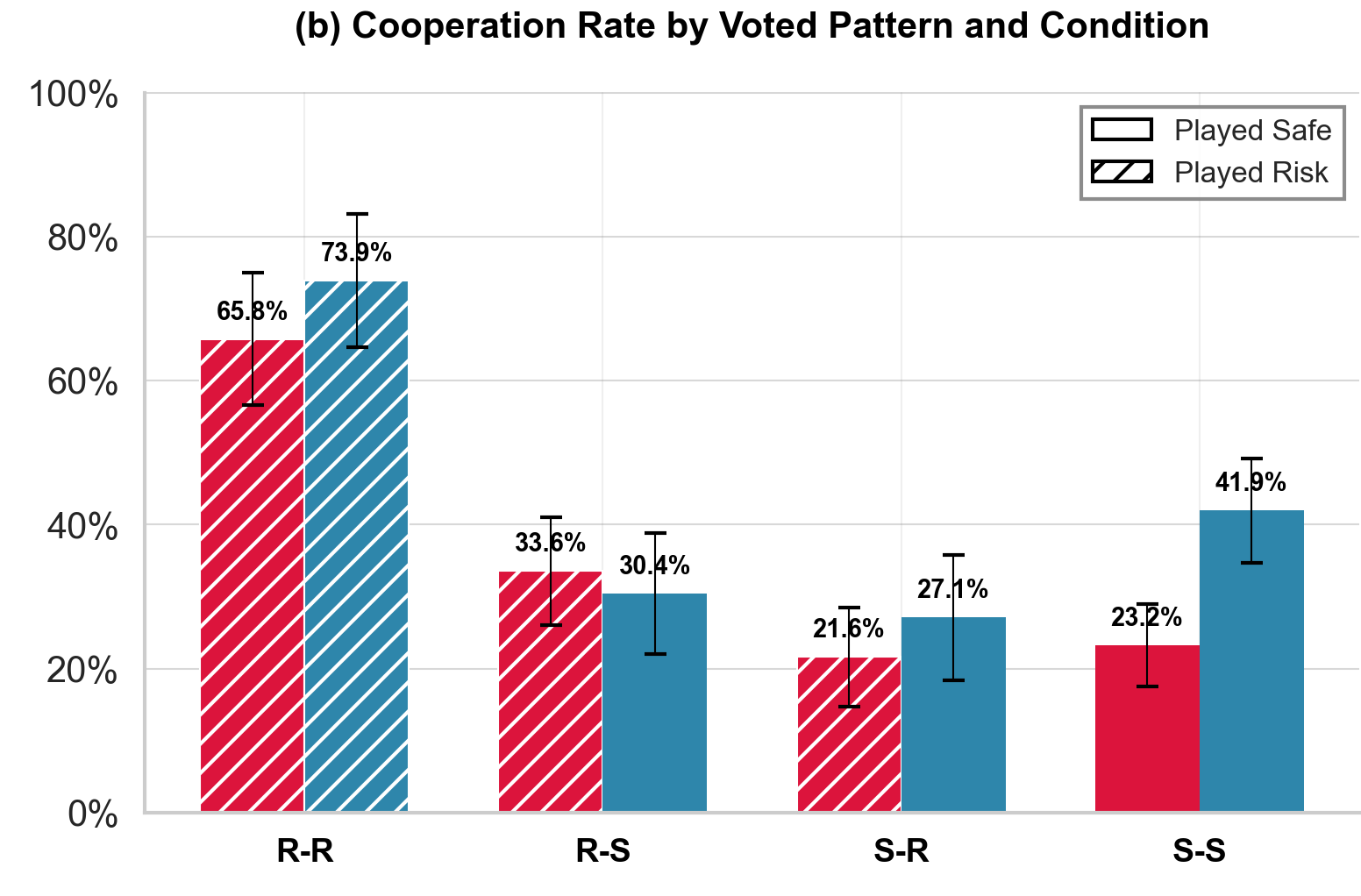
Mutual agreement, not the game, drives cooperation

65.8-73.9%

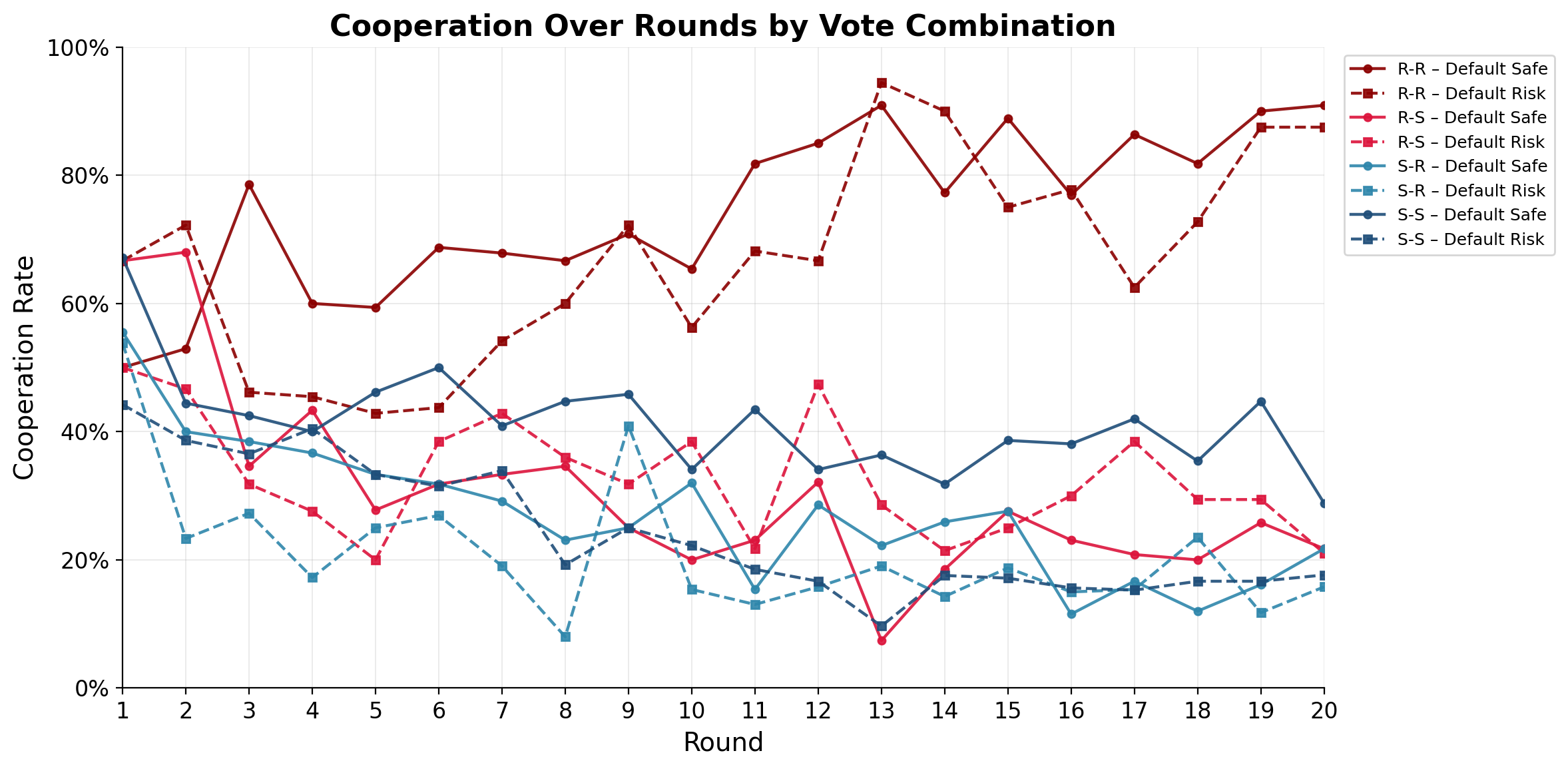
When both vote Risk (R‑R), cooperation is highest, and converges across defaults (66% under Default Risk).

21.6%

Lowest cooperation when forced to play Risk.

41.9% - 23.2% 

When agreeing to play Safe, cooperation is lower when Safe is not the default.
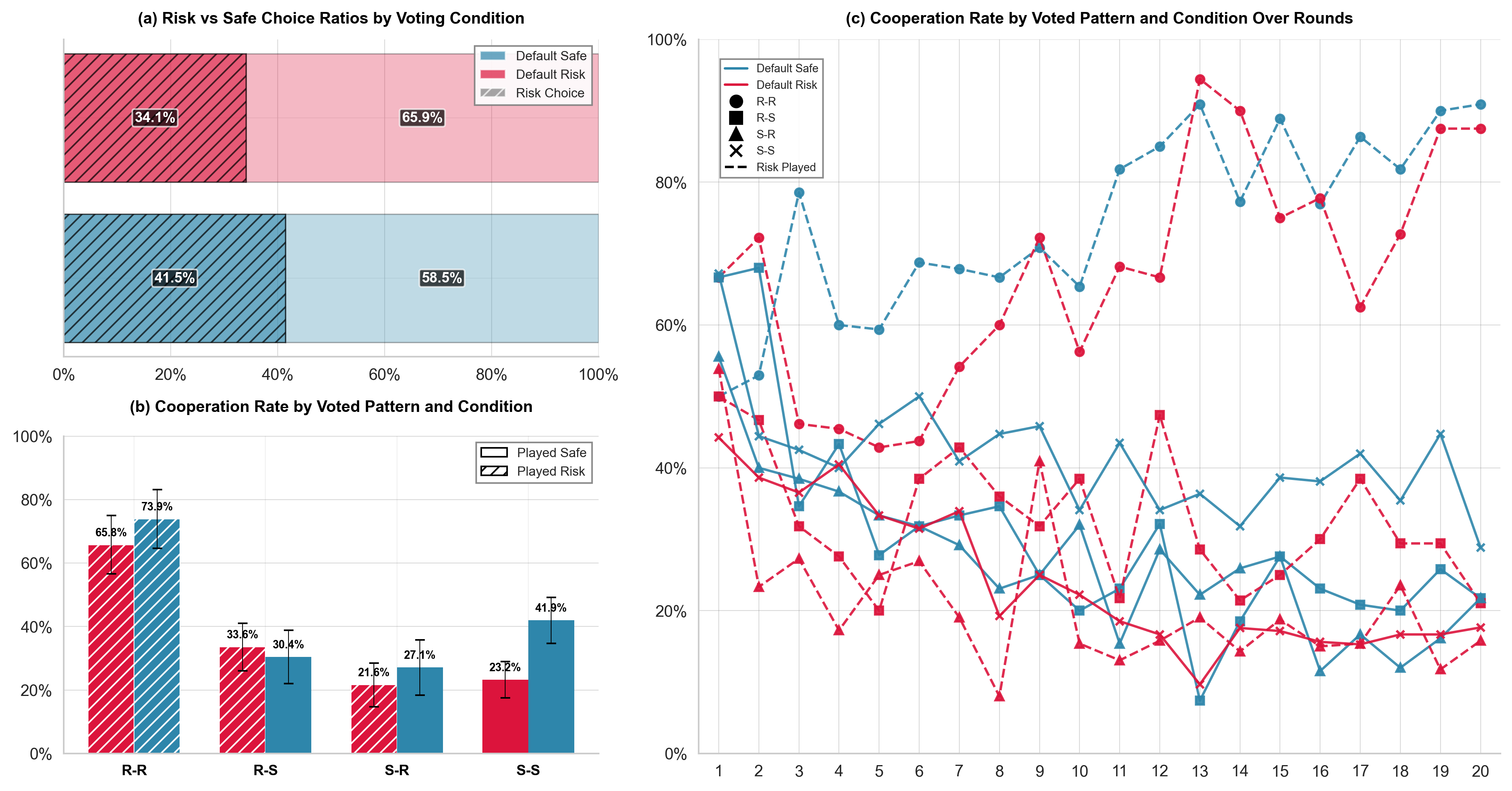
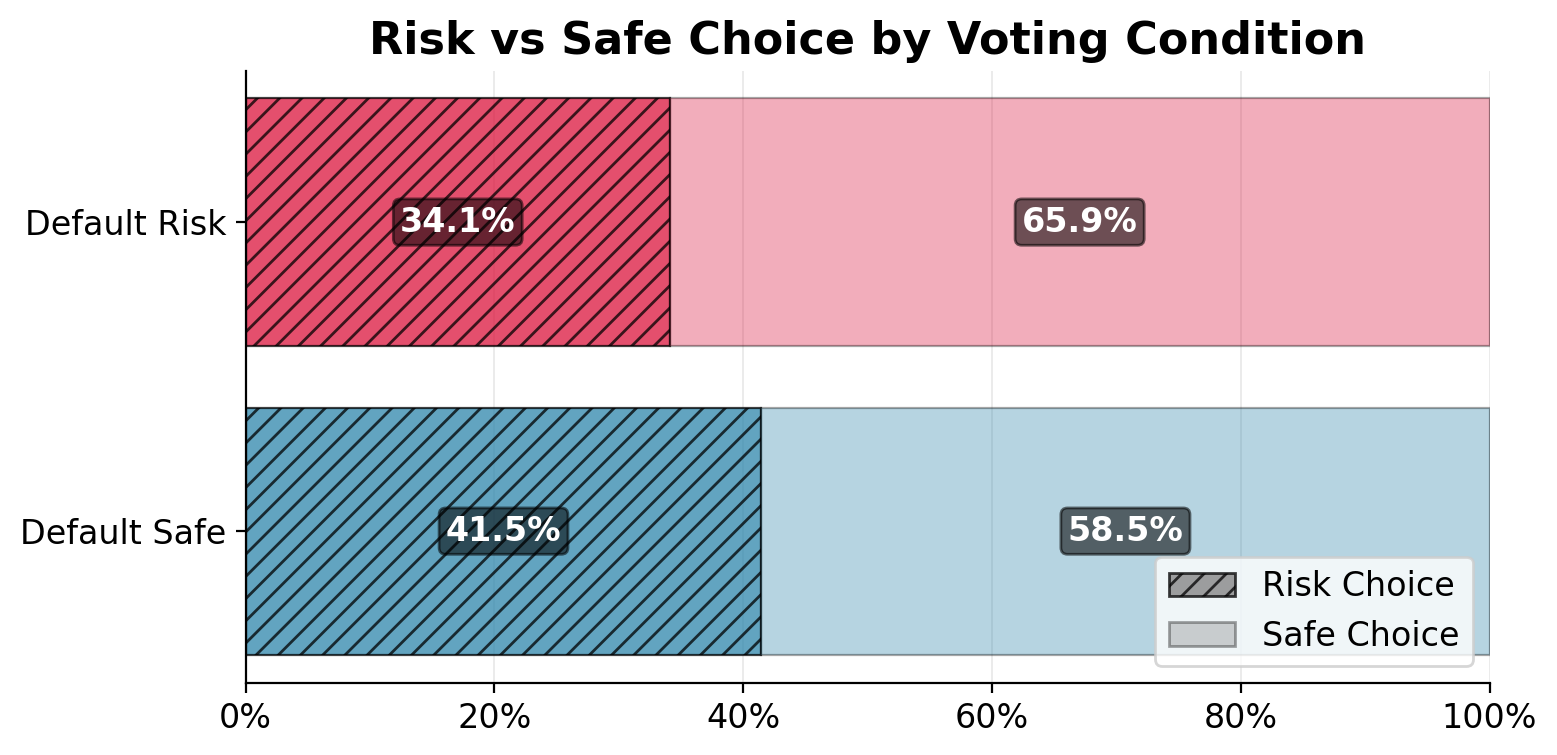
Risk vs safe choice ratios and cooperation by voted pattern Risk vs safe choice ratios Cooperation by voted pattern Cooperation over rounds by vote
All panels Choice ratios By vote Over rounds

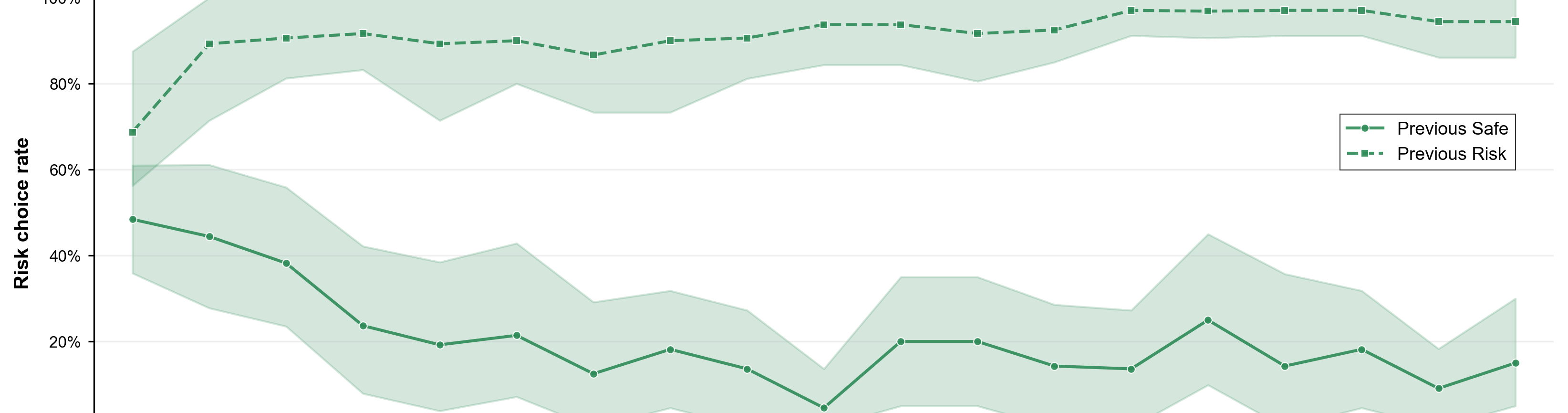
Cooperation under Risk reinforces choosing Risk again

92%

choose Risk again after mutual cooperation in the Risk game.

24%

do so after mutual cooperation in the Safe game.

Cooperation under Risk reinforces taking Risk again, while cooperation under Safe does not. By rounds 6 to 8 pairs self-select into stable Safe or Risk groups and rarely switch after, so Risk becomes a self-sustaining cooperative state.
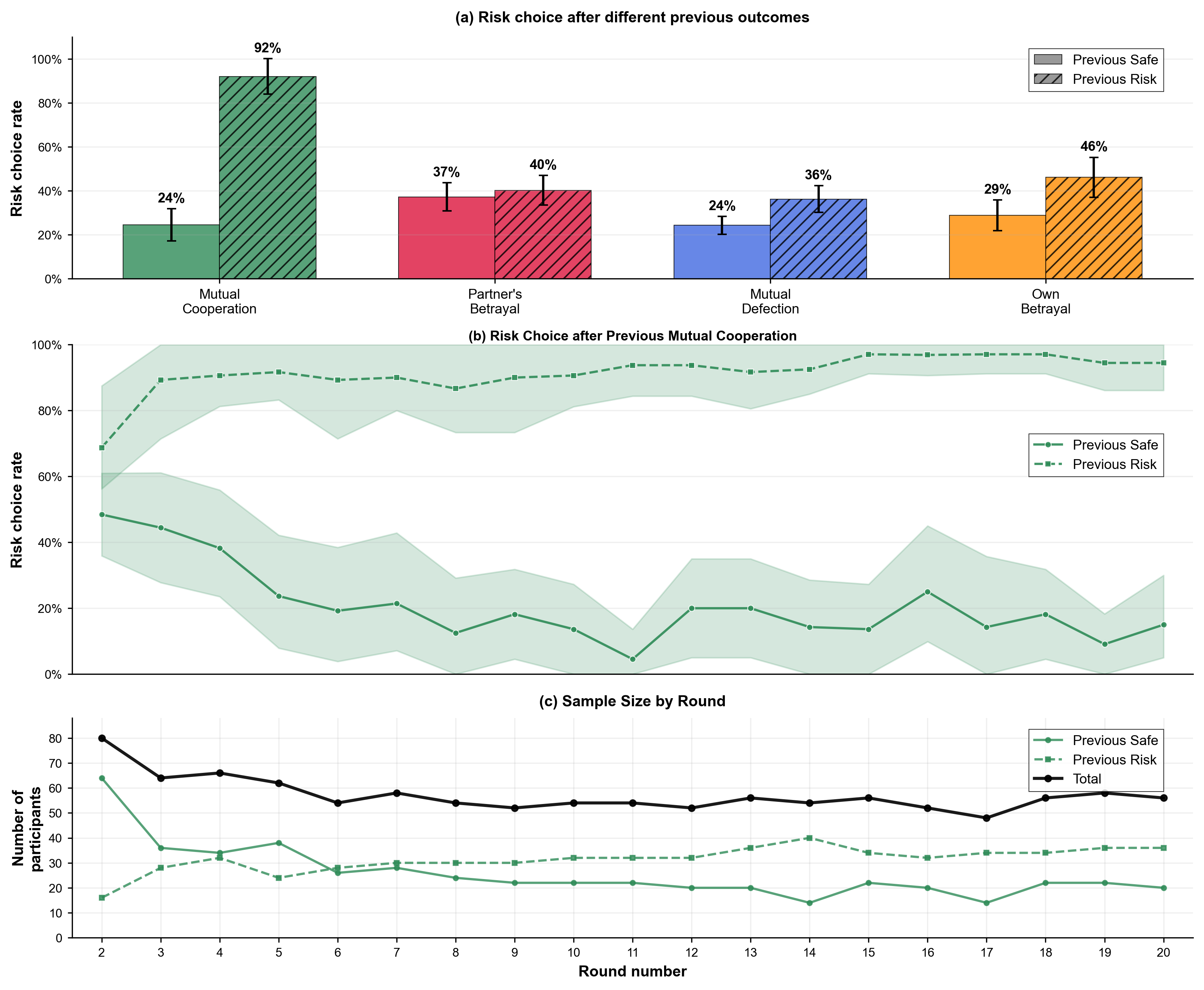
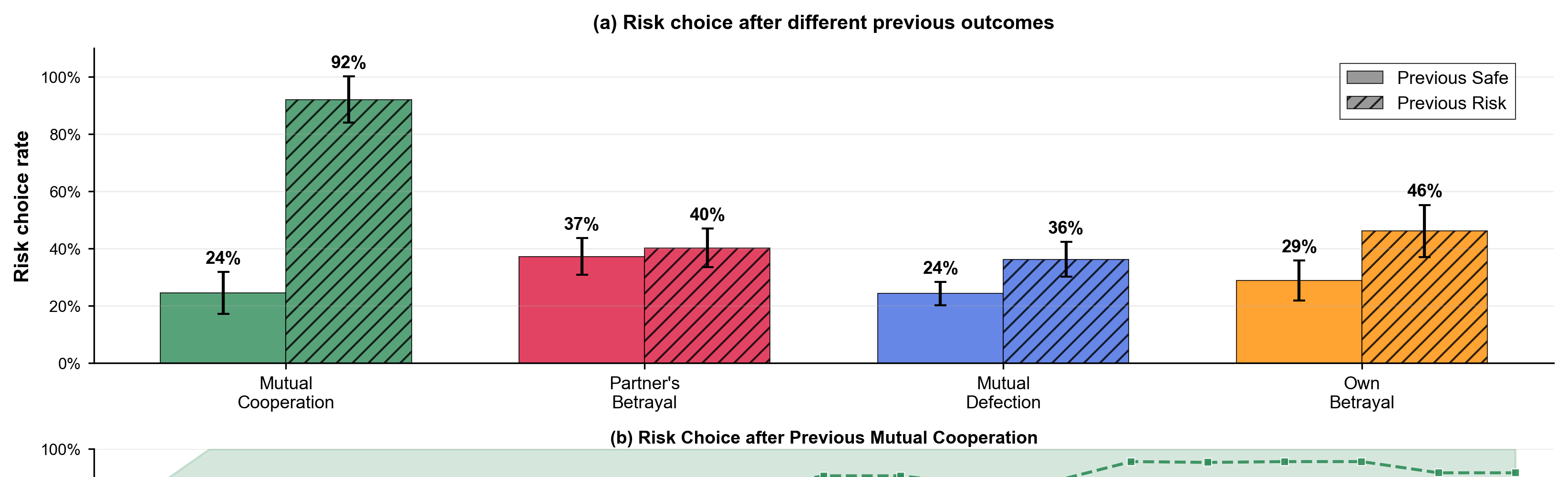
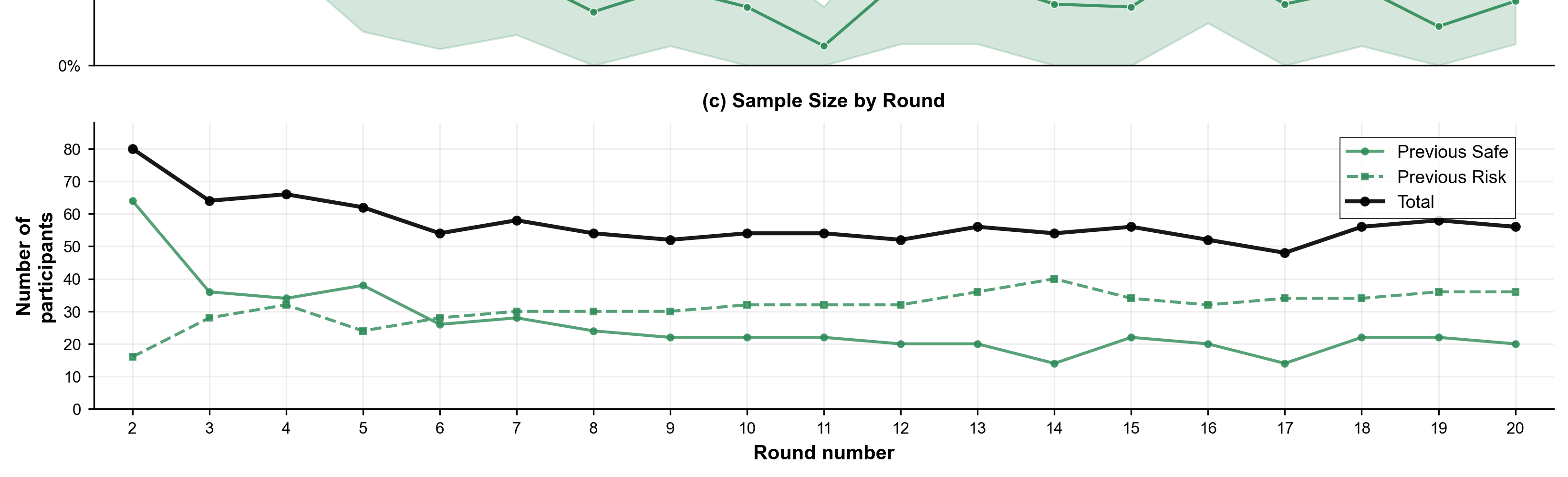
Risk choice after different previous outcomes and over rounds Risk choice after different previous outcomes Risk choice over time after mutual cooperation Sample size by round
All panels By outcome Over time Sample size
Conclusion

Choosing the stakes is part of cooperation

01

Cooperation depends not only on the payoffs, but on whether players jointly chose the game's structure.

02

Mutual agreement to take risk yields the highest, most stable cooperation; risk imposed by a default or a partner collapses it. The yoked controls confirm it is the choosing, not the exposure, that matters.

03

Cooperation under risk is self-reinforcing in voting conditions. * Safe game serves as a restorative fallback after breakdown in pre-determined sequences.

Game choice is part of how players cooperate not only through their moves, but through the games they agree to play.

Thank you

Christian Hilbe
Theo Saroglou
theo.saroglou@it-u.at
Interdisciplinary Transformation University Austria
ICSD 2026, Shimonoseki, Japan
Appendix · why Yoked‑Default‑Risk is lower

In predetermined sequences, the Safe game sustains and restores cooperation

93%

After mutual cooperation in the Safe game, cooperation stays higher in the Safe than in the Risk game (77%).

24%

After mutual defection in the Risk game, cooperation recovers more in the Safe than in Risk Game (13%).

Because Yoked-Default-Risk contains fewer Safe rounds, breakdowns are rarely repaired, so cooperation erodes and fails to recover.
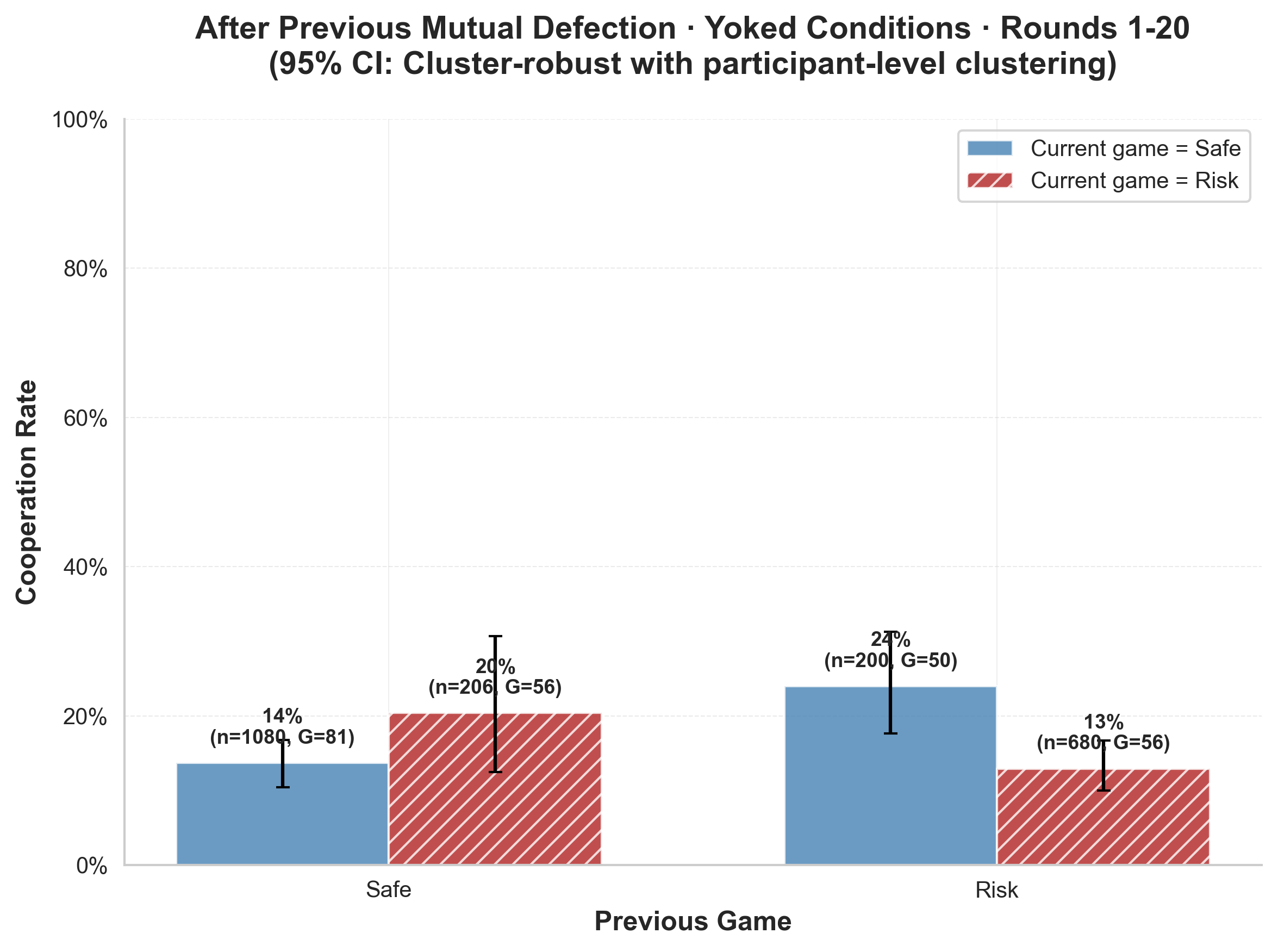
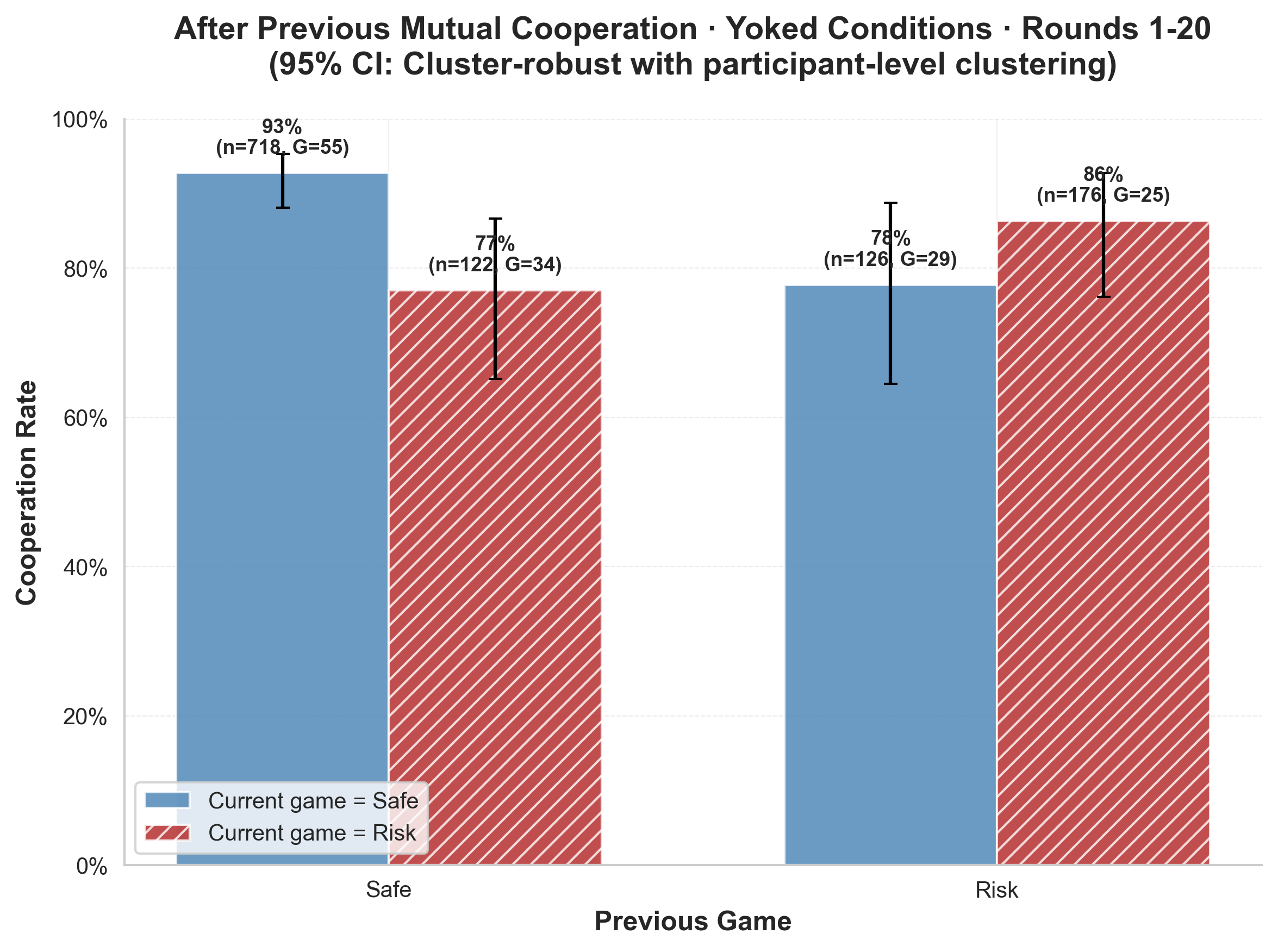
Cooperation after mutual defection in yoked conditions Cooperation after mutual cooperation in yoked conditions
After mutual defection After mutual cooperation
Appendix · why Yoked‑Default‑Risk is lower

More Risk games in the sequence, lower cooperation

−1.97

percentage points of cooperation per +10pp of Risk games in a pair's sequence.

The more Risk rounds a predetermined path contains, the lower the pair's cooperation. Yoked-Default-Risk simply faces more Risk rounds, which drives its lower average.
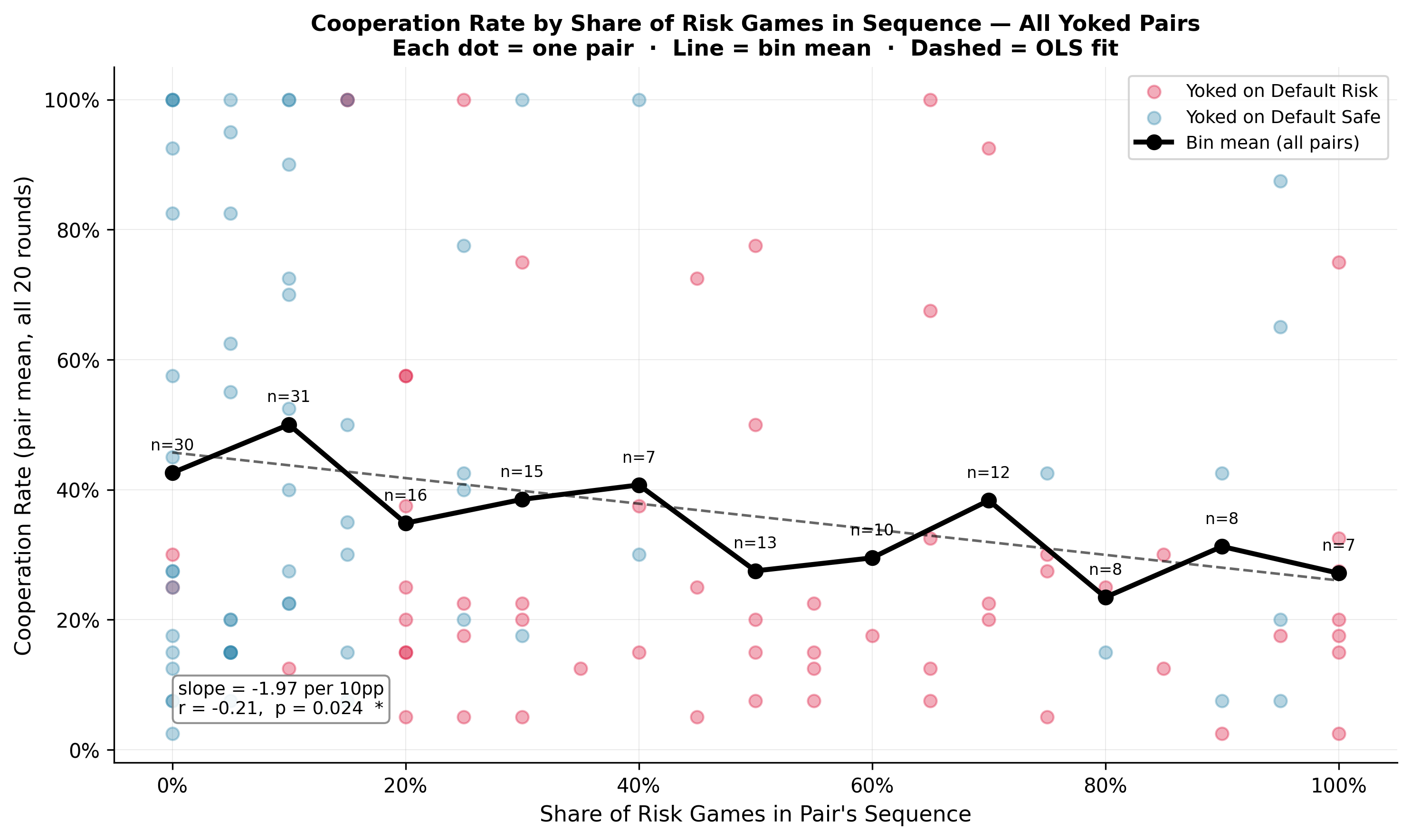
Cooperation rate by share of risk games in sequence, all yoked pairs